
Automatic vs. Semi-Automatic Wire Mesh Welding Machines
Wire mesh welding machines play a crucial role in modern industrial production, finding widespread applications in construction, manufacturing, agriculture, and other industries. With the continuous advancement of technology, wire mesh welding machines have become more automated and intelligent. This article will compare automatic and semi-automatic wire mesh welding machines, highlighting their characteristics, application scenarios, and selection suggestions.
Table of Contents
1. Automatic Wire Mesh Welding Machines
1.1 Working Principle
1.2 Features and Advantages
1.3 Application Scenarios
1.4 Common Models and Brands
2. Semi-Automatic Wire Mesh Welding Machines
2.1 Working Principle
2.2 Features and Advantages
2.3 Application Scenarios
2.4 Common Models and Brands
3. Comparison Between Automatic and Semi-Automatic Wire Mesh Welding Machines
4. Selection Suggestions for Wire Mesh Welding Machines
5. Classification of Wire Mesh Welding Machines
6. Future Development Trends of Wire Mesh Welding Machines
7. Safety Precautions for Wire Mesh Welding
8. Conclusion
1. Automatic Wire Mesh Welding Machines
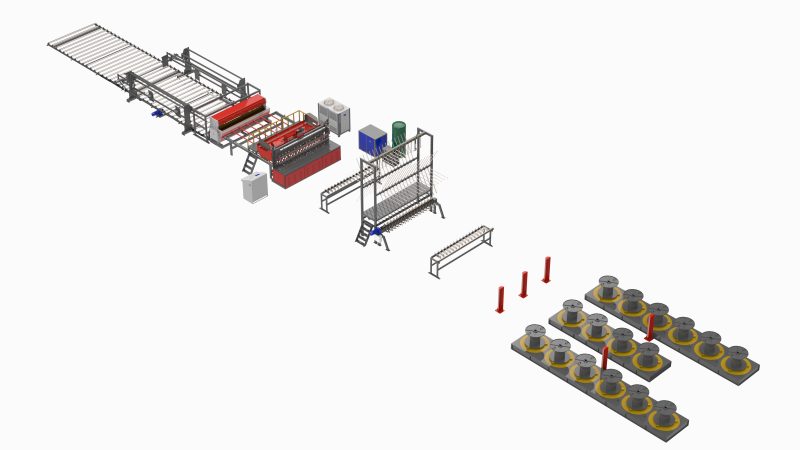
Automatic Wire Mesh Welding Machines
1.1 Working Principle
The automatic wire mesh welding machines weld iron wires together through resistance welding. The welding quality can be adjusted by setting the welding current and welding time through the touch screen. The servo motor can be controlled by the touch screen to pull the mesh to make different hole sizes.
1.2 Features and Advantages
- High Production Efficiency: High degree of automation and fast production speed.
- Stable Welding Quality: Uniform and consistent weld seams.
- Simple Operation: Only requires parameter setting to achieve automated production.
- Wide Range of Applications: Suitable for producing various specifications of wire mesh.
1.3 Application Scenarios
- 2.3.1 Construction Industry: Reinforced concrete mesh, fence mesh, floor slab mesh, etc.
- 2.3.2 Industrial Manufacturing: Sieve mesh, filter mesh, conveyor belt mesh, etc.
- 2.3.3 Other Industries: Agricultural fencing, decorative mesh, etc.
1.4 Common Models and Brands
Common models of automatic wire mesh welding machines include DP-AW and DP-FP, and brands include RKM, DAPU, etc.
2. Semi-Automatic Wire Mesh Welding Machines


2.1 Working Principle
Semi-automatic wire mesh welding machines use a welding torch to manually guide the welding wire. The welding wire is continuously fed by a wire feeder, and the arc melts the welding wire and workpiece to form a weld seam.
2.2 Features and Advantages
- High Flexibility: Suitable for welding workpieces of various shapes and sizes.
- Simple Operation: Operators only require simple training to get started.
- Lower Cost: Lower equipment investment.
2.3 Application Scenarios
- 2.3.1 Small-batch Production: Suitable for enterprises with small production volumes.
- 2.3.2 Special-shaped Welds: Semi-automatic welding machines have an advantage for welding workpieces with complex shapes.
2.4 Common Models and Brands
Common models of semi-automatic wire mesh welding machines include DP-FM reinforcing wire mesh welding machines and DP-GW, and brands include RKM, DAPU, etc.
3. Comparison Between Automatic and Semi-Automatic Wire Mesh Welding Machines
3.1 Tabular Comparison
| Feature | Automatic Wire Mesh Welding Machine | Semi-Automatic Wire Mesh Welding Machine |
|---|---|---|
| Production Efficiency | High | Lower |
| Welding Quality | Stable | Relatively Stable |
| Operation Difficulty | Low | Higher |
| Application Range | Large-scale Production | Small-batch Production, Special-shaped Welds |
| Cost | High | Lower |
3.2 Comprehensive Analysis
Automatic wire mesh welding machines offer high production efficiency and stable welding quality, making them suitable for large-scale production. Semi-automatic wire mesh welding machines are more flexible and have lower costs, making them suitable for small-batch production and special-shaped welds.
4. Selection Suggestions for Wire Mesh Welding Machines
When selecting a wire mesh welding machine, it’s essential to consider the following factors:
- Production Scale: For large-scale production, automatic wire mesh welding machines are generally more suitable due to their higher efficiency and automation level. Semi-automatic wire mesh welding machines are more suitable for smaller production volumes.
- Product Requirements: If the product requires high weld quality, precise dimensions, or specific welding patterns, automatic wire mesh welding machines may be preferable. Semi-automatic welding machines can also handle these requirements but may require more operator skill and time.
- Cost Budget: Consider the initial investment, operating costs, and maintenance costs associated with each type of machine. Automatic wire mesh welding machines typically have higher initial costs but can offer long-term cost savings due to their increased efficiency and reduced labor requirements.
- Operator Skill Level: Semi-automatic wire mesh welding machines generally require more operator skill and training compared to automatic machines. If your operators have limited experience, an automatic machine may be a better choice.
- Factory Layout and Space Constraints: Consider the available space in your factory. Automatic wire mesh welding machines may require more space for installation and operation compared to semi-automatic machines.
By carefully evaluating these factors, you can select the wire mesh welding machine that best suits your specific needs and requirements.
5. Classification of Wire Mesh Welding Machines
In addition to automatic and semi-automatic wire mesh welding machines, there are other types based on welding methods and application scopes:
- Laser Wire Mesh Welding Machines: Utilize high-energy-density laser beams to melt the welding wire and workpiece, offering high welding speed and excellent weld quality.
- Resistance Wire Mesh Welding Machines: Employ the heat generated by electric current to melt the welding wire and workpiece locally, achieving high welding speed and low cost.
- Plasma Wire Mesh Welding Machines: Utilize the high-temperature plasma arc to cut and weld workpieces, suitable for welding thick plates and special materials.
6. Future Development Trends of Wire Mesh Welding Machines
With the continuous improvement of industrial automation levels, wire mesh welding machines will develop in the following directions:
- Intelligence: By introducing artificial intelligence technology, real-time monitoring and control of weld quality can be achieved.
- Digitalization: Utilizing digital technology to collect, analyze, and manage production data.
- Modularization: Wire mesh welding equipment will become more modular, facilitating flexible configuration and expansion.
- Green: Adopting more environmentally friendly energy sources and materials to reduce environmental impact.
7. Safety Precautions for Wire Mesh Welding
- Operators must undergo professional training and be familiar with the operating procedures of the equipment.
- Regular inspections and maintenance of the equipment should be carried out to ensure it is in good working condition.
- Protective eyewear, gloves, and other protective equipment should be worn during welding operations.
- The welding area should be well-ventilated to prevent the accumulation of harmful gases.
8. Conclusion
Automatic and semi-automatic wire mesh welding machines each have their advantages and disadvantages. The choice of equipment should be based on specific production needs. With the continuous development of technology, wire mesh welding machines will become more intelligent, efficient, and environmentally friendly.
 English
 Russian
 Arabic
 Hindi
 Persian
 Portuguese
 French
 Panjabi
 Turkish
 Urdu
 Vietnamese
 Ukrainian
 Thai
 Kazakh
 Polish
 Romanian
 Danish
 Korean