
How Mesh Welding Machine Works
Welded wire mesh is one of the most in-demand products in UK’s construction and industrial sectors. It is widely used in reinforced concrete structures, fencing systems, mining applications, and infrastructure projects. For many UK manufacturers, the main question is: how to produce mesh with consistent quality, high strength, and at a competitive cost?
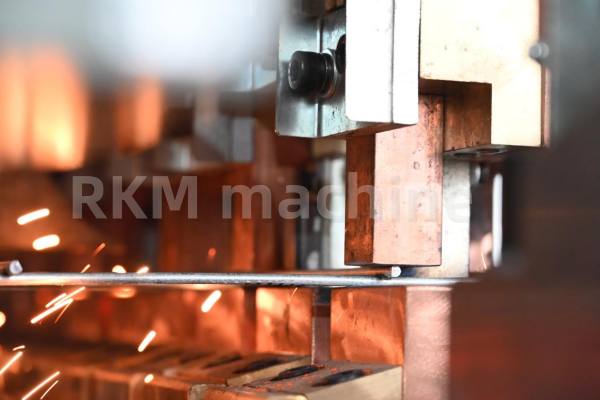
modern mesh welding machine
The answer lies in modern mesh welding machines — designed to provide stable performance, long service life, and efficiency even in demanding production environments.
The Principle of Mesh Welding
Mesh welding machines operate on the principle of resistance welding (Joule heating). When electric current passes through the contact points of crossing wires, it generates heat, instantly bringing the metal to a plastic or melting state. At this moment, the wires are pressed together, creating a solid and reliable weld joint.
The welding current is extremely high, but the duration is very short (only tens to hundreds of milliseconds).
This ensures the weld is strong, while the wires themselves are not overheated or deformed.
The result is a durable and precisely sized welded mesh that meets strict construction standards.
Machine Design and Structure
A basic mesh welding line can be built by connecting several welding heads powered by one or more welding transformers. For industrial-scale production, however, advanced systems integrate:
Automatic wire feeding devices to guarantee consistent spacing.
PLC and servo motor control for high accuracy and repeatability.
Quick change tooling to adapt different mesh sizes and wire diameters.
Robust steel frame designed for long-term operation with minimal maintenance.
This type of machine structure is especially important for British manufacturers, who often operate in heavy-duty conditions and require equipment that is strong, stable, and easy to maintain.
Benefits for British Producers
By installing a professional mesh welding machine, local producers can solve several common pain points:
Labor shortage & high costs: Automation reduces the need for manual welding and lowers overall labor expenses.
Quality consistency: Machines guarantee uniform weld strength and accurate mesh dimensions — critical for construction projects under strict GOST standards.
Higher productivity: Continuous production capability allows factories to meet rising demand in infrastructure and housing.
Flexibility: One machine can produce different mesh sizes, supporting multiple market segments (construction reinforcement, fencing, cages, mining screens).
Durability in harsh environments: Machines are built with strong mechanical frames, reliable electrical components, and cooling systems suitable for long production shifts.
Why Choose Our Mesh Welding Machines?
For British manufacturers, choosing the right partner is as important as choosing the right machine. With our equipment, you get:
European-standard technology at competitive pricing.
Customization options to match British wire diameters and mesh standards.
On-time delivery and installation, with full technical support.
Training and service support, so your operators can quickly start production.
We understand that in UK, reliability and after-sales service are not optional — they are essential. That is why our machines are designed and supported to ensure long-term value and low operating costs.
Conclusion
The demand for welded mesh in UK will only grow as construction and infrastructure projects expand. A modern mesh welding machine is not just equipment — it is an investment in product quality, factory efficiency, and long-term competitiveness.
If you are planning to upgrade your production line or start new mesh manufacturing, we are ready to provide you with the best solution within your budget.
 English
 Russian
 Arabic
 Hindi
 Persian
 Portuguese
 French
 Panjabi
 Turkish
 Urdu
 Vietnamese
 Ukrainian
 Thai
 Kazakh
 Polish
 Romanian
 Danish
 Korean