
Wire Straightening Machines: Theoretical Research and Model Development
In industries that rely on precision manufacturing, ensuring the straightness of bars and wires is crucial. Products like steel bars, tubes, and rods often require a straightening process to correct imperfections caused by various production techniques, such as drawing or rolling. While modern manufacturing processes have advanced significantly, the challenge of achieving precise straightness in long and small-diameter bars persists. This is where wire straightening machines play a vital role. Understanding the theoretical underpinnings of these machines and how they work is key to improving the performance and efficiency of manufacturing operations.
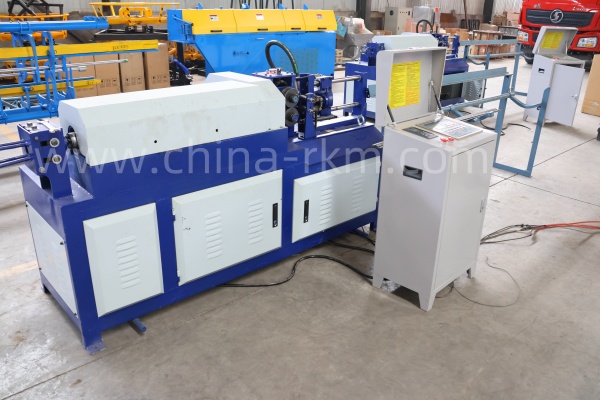
The Importance of Straightening in Manufacturing
The need for straightening comes from the inherent imperfections in bars produced through processes like drawing and rolling. The straightness of these bars can often be compromised, leading to issues with product quality and further processing. Cross-roll straightening, plastic bending, and reverse bending are common methods used in modern machines to address these issues. The theoretical principles governing these methods, such as the application of bending moments and the resulting curvature, are essential for designing machines that restore bars to their desired shape and specifications.
As bar straightening requires bending and unbending operations, the key factor to consider is the profile of the rollers used. Rollers in machines like cross-roll straighteners and skew-roll straighteners must be carefully designed to ensure effective bending and minimal distortion. Research on roller profiles, such as that done by Li et al., has provided valuable insights into achieving the correct curvature and improving the overall straightening process.
The Role of Rollers and Straightening Processes
In bar straightening, the rollers’ design is of paramount importance. The profile of the rollers determines how the bars are bent and unbent, which affects the final straightness. The rollers used in cross-roll straightening machines, for example, are often skewed to achieve optimal results. Skew-roll machines, such as six-roll and multi-staggered roll designs, allow for better control over the bending and unbending process, distributing the forces more evenly across the bar.
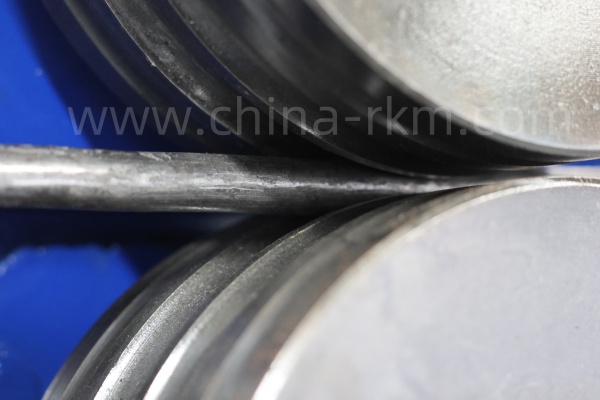
Researchers have studied various roller designs and their effects on straightening efficiency. For instance, six-roll straighteners use skew-roll arrangements that enable precise control over the bar’s curvature. The ability to adjust the angle between supporting and loading rollers allows for customization based on the material and desired straightness, making this machine type versatile for different bar sizes and configurations.

Furthermore, the introduction of standstill-locking straightening systems and multi-step straightening control systems (MSSC) has improved both the speed and accuracy of the straightening process. These systems help minimize straightness errors and improve the overall quality of the finished product, especially for larger bars and heavy-duty applications.
Residual Stresses and Their Impact
One of the critical factors influencing the quality of straightened bars is the residual stress generated during the process. Residual stresses can distort the shape of the bar, affecting its performance in downstream processes. Through advanced numerical modeling and finite element analysis (FEA), researchers have been able to predict and analyze the distribution of these stresses and develop strategies to minimize their impact.
Residual stress analysis is essential in cross-roll straightening, where the repeated bending of bars creates internal stresses that may compromise the straightness. By optimizing the roller profiles and adjusting parameters such as roller angles, it is possible to reduce residual stresses and improve the straightness of bars, ensuring better performance in subsequent manufacturing stages.
Simulation tools and FEA have proven invaluable in understanding the dynamics of bar straightening and predicting the behavior of materials under different loading conditions. Researchers such as Mutrux et al. have used simulation techniques to predict curvature reduction in cross-roll straightening, helping manufacturers optimize the straightening process and achieve higher-quality results.
Theoretical and Numerical Modeling in Bar Straightening
The advancement of theoretical and numerical models in bar straightening has been crucial for improving machine designs and processes. Researchers have used mathematical models to predict how different bar geometries and roller configurations will affect the straightening process. These models consider factors such as material properties, strain-hardening, and the Bauschinger effect, which describes the material’s response to reversed loading.
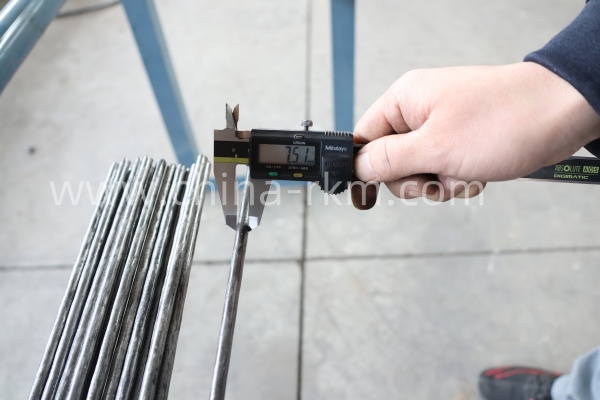
Through finite element simulations, it has become easier to study the effects of roller arrangement and material properties on the straightening process. For instance, simulations can predict the optimal angle for rollers in cross-roll straightening machines, helping to maximize straightness while minimizing material waste.
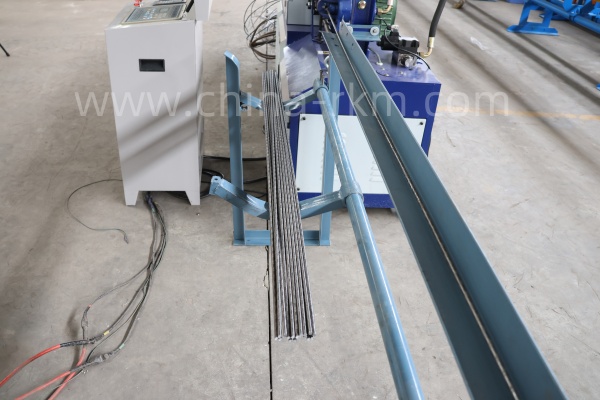
RKM’s Wire Straightening Machines: Precision and Innovation
RKM is at the forefront of wire straightening technology, incorporating the latest advancements in European design and engineering. Our wire straightening machines are built using cutting-edge techniques, ensuring high precision, efficiency, and durability in the straightening process. Whether for small-diameter round bars, large structural beams, or high-tensile materials, RKM offers solutions that meet the strictest industrial standards.
Our machines utilize advanced roller profiles and adjustable configurations to provide optimal straightening results for a variety of materials. With features like skew-roll and multi-staggered roll systems, RKM’s wire straightening machines offer unmatched control over the bending and unbending processes, minimizing residual stresses and maximizing product quality.
RKM’s integration of multi-step straightening control systems (MSSC) and standstill-locking mechanisms ensures that our machines can handle high-speed production while maintaining the accuracy and precision required in modern manufacturing. By leveraging European innovations, RKM delivers machines that improve operational efficiency, reduce material waste, and ensure consistent, high-quality results.
For manufacturers seeking to enhance their bar straightening operations, RKM provides the perfect blend of technology, performance, and reliability. Choose RKM’s wire straightening machines to achieve superior straightness and elevate the quality of your production processes.
 English
 Russian
 Arabic
 Hindi
 Persian
 Portuguese
 French
 Panjabi
 Turkish
 Urdu
 Vietnamese
 Ukrainian
 Thai
 Kazakh
 Polish
 Romanian
 Danish
 Korean